One missing tooth
A single implant supports its own crown without normally needing to prepare the neighbouring teeth.
See the single-tooth example ↓DENTAL IMPLANTS, CLEARLY EXPLAINED
From one missing tooth to a complete fixed arch, this guide explains what an implant is, how treatment works and what representative treatment costs look like before you decide whether to proceed.
WHICH TYPE OF IMPLANT TREATMENT?
A single implant supports its own crown without normally needing to prepare the neighbouring teeth.
See the single-tooth example ↓Two or more implants can support a fixed bridge, replacing several teeth without one implant for every missing tooth.
See treatment examples →All-on-Four and All-on-Six use a carefully planned group of implants to support a fixed full-arch restoration.
Explore full-arch implants →THREE SIMPLE COMPONENTS
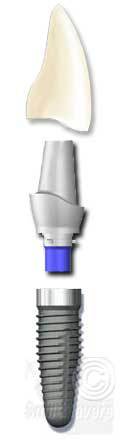
The visible tooth is only one part of the restoration. The crown, abutment and implant work together as one system.
The visible restoration is shaped and coloured to work with the rest of your smile.
The connector joins the restoration above the gum to the implant beneath it.
A titanium implant sits in the jawbone and provides the stable foundation for the final tooth or bridge.
THE TREATMENT JOURNEY
Exact timing depends on the tooth position, bone and treatment plan, but most conventional implant cases follow the same broad sequence.
Examination, imaging and a written treatment plan establish what can be placed and what restoration will be needed.
The implant is surgically positioned in the jawbone. Additional procedures such as grafting are only included when required by the plan.
As a guide, we normally allow around 3 months for lower-jaw implants and around 4 months for upper-jaw implants before the final restorative stage.
The implant is uncovered, the restorative stage begins and your custom crown or bridge is produced and fitted.
WHY PEOPLE CHOOSE IMPLANTS
Implants are anchored in the jawbone rather than resting on the gum like a removable denture.
The final crown or bridge is designed around the position, proportions and colour of the surrounding smile.
A single implant can replace a tooth without normally relying on adjacent teeth to carry a conventional bridge.
The implant transfers chewing forces into the jaw and can help preserve bone around the replaced tooth position.
EXAMPLE TREATMENT COSTS
These are representative current examples, not a quotation. Your clinical assessment determines the final treatment plan.
BUDAPEST EXAMPLE
Camlog implant, abutment and porcelain crown.
| Treatment | Price |
|---|---|
| 1 Camlog Implant10% Camlog implant discount applied | £539was £599 |
| 1 Camlog Screw Retained Abutment | £185 |
| Healing guide: approximately 4 months upper jaw / 3 months lower jaw | |
| Implant Uncovering / Exposure | £50 |
| Impressions, anaesthetics, healing screw | Free |
| Porcelain crown fused to metal anchored on implant | £239 |
The implant itself is not priced differently by tooth position or clinic; the overall example differs because other treatment components and stages are priced differently.
BUDAPEST EXAMPLES
Porcelain bonded bridges with the implant exposure fees included.
| Example | Implants | Exposure | Example total |
|---|---|---|---|
| All-on-FourFixed 12-unit porcelain restoration | 4 | £200 £50 × 4 | £5,678was £6,204 |
| All-on-SixFixed 12-unit porcelain restoration | 6 | £300 £50 × 6 | £7,227was £7,872 |
Included above: implant uncovering / exposure. Impressions, anaesthetics and healing screws are free in these examples.
Additional when required: scans, extractions, temporary teeth, pink ceramic and other procedures that are not part of the base example.
A REAL PATIENT JOURNEY
Her story is a reminder that implant treatment is not just about replacing a gap. It can be part of restoring everyday confidence, comfort and function after significant tooth loss.
Read Louise's Story →COMPLEX IMPLANT CASES
Our lead surgeon is a GDC-recognised Specialist Oral Surgeon with more than 30 years of implant and oral-surgery experience, including full-arch rehabilitation, sinus lifts and bone grafting.
COMMON QUESTIONS
The old page placed every answer in one long stream. Here the detail stays available without overwhelming the main treatment guide.
It is the healing process in which bone forms a stable connection around the titanium implant. This is why conventional implant treatment normally includes a healing period before the final restoration is completed.
Implant placement is carried out with anaesthesia. After surgery, some swelling, tenderness or bruising can occur. Your surgeon provides specific aftercare and pain-management instructions for your procedure.
For a conventional case, the implant is placed first and allowed to heal before the restorative stage. As a guide, our lower-jaw implants commonly heal for around 3 months and upper-jaw implants around 4 months. Grafting or more complex surgery can change the timetable.
Yes. Implants can support individual crowns, implant bridges or a complete fixed arch. The number of implants is determined by the anatomy, number of teeth being replaced and the design of the final restoration.
Low bone does not automatically rule out implant treatment. The surgeon may assess grafting, sinus-lift procedures or a different implant plan. A scan and clinical assessment are required before recommending an approach.
Implants are designed as a long-term solution, but longevity varies with health, oral hygiene, bite forces, maintenance and other clinical factors. The crown or bridge above an implant is a separate component and may require maintenance or replacement over time.
No single option is right for everyone. Implants provide a fixed foundation and can avoid some of the movement associated with removable dentures, but suitability, surgery, cost and maintenance all need to be considered individually.
YOUR NEXT STEP
A consultation is the point where general information becomes an individual treatment plan.